


Abstract
When working with sensitive cell cultures, even the smallest inconsistency like a brief temperature drop or CO₂ level shift affect the results in conventional incubators. The challenge is to keep conditions perfect while protecting the cultures from contamination. The approach of modern CO₂ incubators are more than metal boxes. They offer a high-tech environment built with precision, safety, and easy to manage features. From smarter CO₂ sensors to better heating systems, incubators now have come up equipped with solutions designed to meet today’s demanding lab workflow. This article explores those improvements, breaking down the core features and strategies behind the incubators helping researchers to achieve more reliable outcomes.
Introduction
Researchers or laboratory experts spend hours, days, or even weeks cultivating precious cells, they know how vital CO₂ incubator truly is. It is not just equipment; it is a trusted partner in research labs. Working in stem cell research, pharmaceuticals, or academic labs, the incubator’s job is simple but critical, maintain an ideal environment for cell growth. But as simple as that sounds, the execution requires complexity. That is why incubator technology has steadily evolved tackling inconsistent temperatures or the risk of contamination. The main goal is growing and maintaining healthy cell cultures and today’s CO₂ incubators are smarter, more reliable, and easier to use than ever before to carry out the research work. They offer practical features that simplify everyday lab work. When it comes to picking the right incubator, most scientists focus on three key things, how dependable it is, how well it prevents contamination, and how simple it is to operate. In the sections that follow, we will walk through the most important features that make modern CO₂ incubators such an essential part of today’s cutting-edge research environment.
Content
1. The Accuracy of CO₂ Sensing
CO₂ levels directly impact pH in your culture media, so even minor fluctuations can stress or kill your cells. Incubators typically measure CO₂ in one of two ways:
Thermal Conductivity (TC) Sensors are affordable and get the job done, but they can be thrown off by humidity or temperature changes (like when you open the door too often).
Infrared (IR) Sensors, on the other hand, are much more precise. They read the CO₂ based on how it absorbs infrared light that is completely unaffected by room conditions. But they cost a bit more, if you are working with sensitive cultures or long-term experiments, the reliability is worth it.
2. Temperature Control Systems
The warmth inside incubator is critical for cell growth. Two main systems help maintain it:
Water-Jacketed Models use a built-in water reservoir that naturally retains heat. These are great at holding steady temps, especially if your lab is prone to power outages.
Direct-Heat or Radiant-Wall Incubators skip the water and instead use heated walls and gentle air circulation. They heat up quickly and recover faster after the door’s opened, which is a big plus during busy lab days.
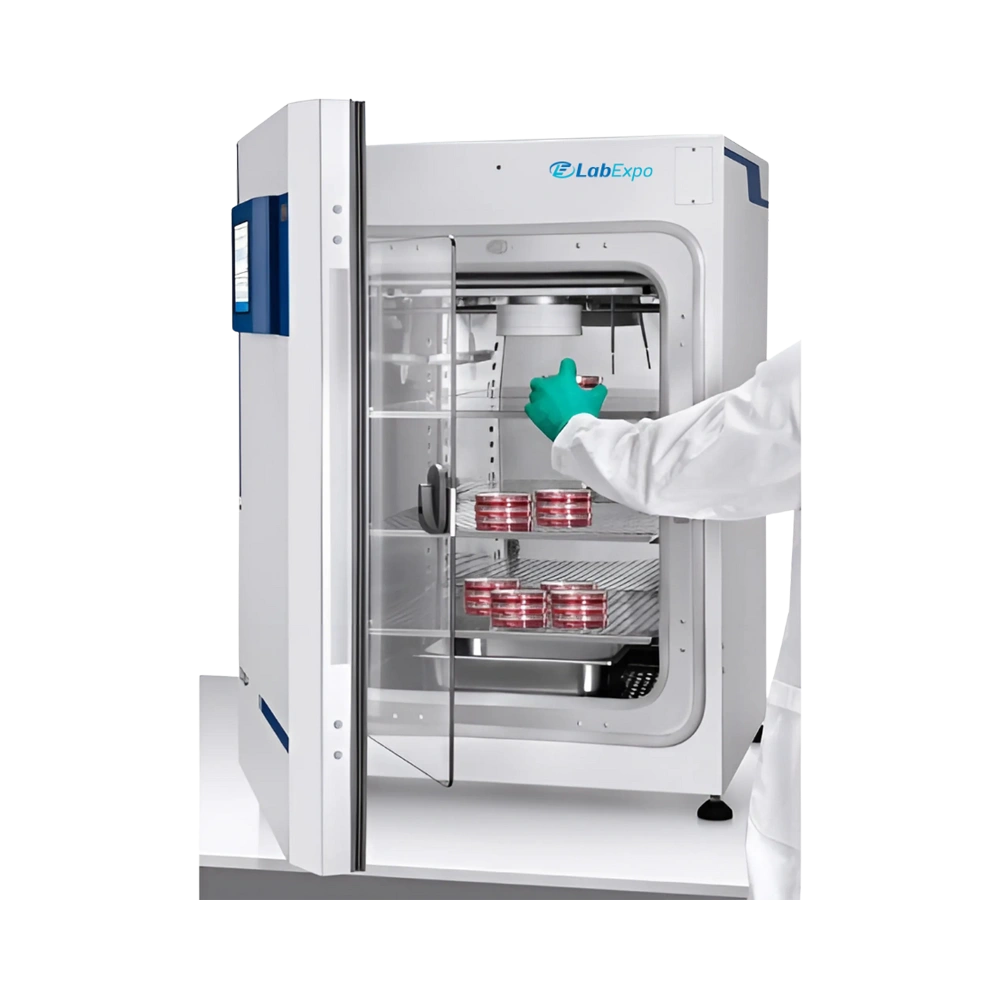
Lab Expo’s range of CO₂ incubators are designed to maintain high humidity and reduce media evaporation, they incorporate integrated water pans. For contamination control, these incubators are equipped with advanced HEPA filtration systems and integral UV sterilization, offering a clean and safe atmosphere for sensitive research work.
3. Humidity
High humidity (usually 95% or more) prevents the evaporation of culture media. Most incubators manage this with a simple pan of water. It’s a low-tech solution, but it works beautifully.
Some higher-end models offer heated humidity systems, which can be helpful in dry climates or for high-throughput labs. Just keep an eye out for condensation—too much can create puddles and even promote mold growth.
4. Fighting Contamination
Contamination is every cell culturist’s nightmare. Thankfully, CO₂ incubators now come armoured with multiple defences:
HEPA Filters clean the air before it reaches your cultures.
Copper Interiors or Coated Shelves naturally kill bacteria and fungi.
Rounded Corners & Removable Shelves make cleaning easier.
High-Heat Decontamination Cycles (some reaching 90 °C) can sterilize the entire chamber overnight.
Together, these features give you peace of mind—because no one wants to open the door and find weeks of work ruined by a rogue microbe.
5. Ease of Use
Modern CO₂ Incubators offer intuitive interfaces, alarms for every major parameter, and even password protection to avoid errors.
Lab Expo CO₂ Incubators are compact benchtop models with reversible doors, caster wheels, and stack kits, these add even more flexibility to help fit the unit into lab like a puzzle piece.
Final Thoughts
Whether you are growing stem cells, running drug trials, or just starting out in cell biology, the CO₂ Incubator is one of the most important tools in your lab. Equipped with IR sensing, radiant heating, smart humidity control, and contamination safeguards, the instrument can save time, protect samples, and make the experiments more consistent.
Modern incubators are more than controlled boxes, they are finely tuned environments, designed to give your cells their best shot at success. And when your cells thrive, so does your research.
How Lab Expo Can Help
The CO₂ incubator is thoughtfully engineered to create a stable, contamination-free environment for sensitive cell cultures. At Lab Expo we offer various types of CO2 Incubator that includes Air Jacketed CO₂ Incubators, Water Jacketed CO₂ Incubators, CO₂ Incubator Shakers, and precise Cell Culture Incubators. These instruments are very efficient for research labs for their-
Even Conditions, Top to Bottom: The incubator keeps temperature, humidity, and CO₂ levels consistent throughout the entire chamber. Whether the samples are on the top shelf or the bottom, they will get the same optimal conditions with around 37 °C, 5 % CO₂, and over 95 % humidity.
Quick Recovery After Door Openings: Every time when the door gets opened, conditions can shift but not for long. This system quickly brings the temperature and gas levels back to ideal values, minimizing stress on your cultures and reducing downtime.
Clean Air: An integral HEPA filter constantly purifies the circulating air, capturing over 99.99% of airborne contaminants. This gives your cultures an extra layer of protection against infections and unwanted particles.
Real-Time Monitoring: Smart sensors placed directly inside the chamber continuously monitor temperature, CO₂, and humidity levels. This ensures real-time adjustments and accurate control, so you can trust the environment your cells are growing in.