



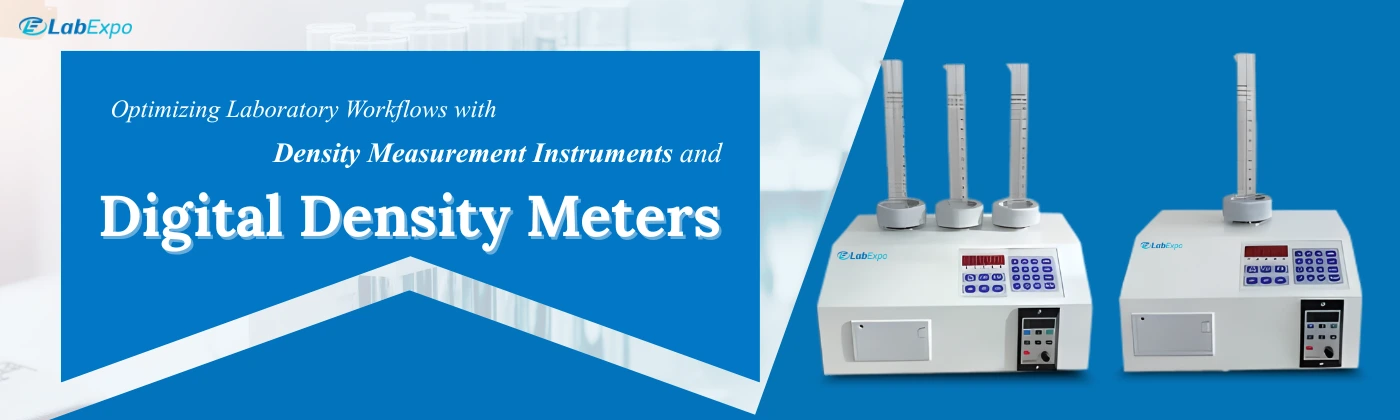
Optimizing Laboratory Workflows with Density Measurement Instruments and Digital Density Meters
Effective laboratory management relies on accurate material assessment, which typically depends on a density measuring instrument to provide accurate and reproducible results. Density measurement instruments simplify the tap density and powder density test and replace user fatigue and are suitable for a variety of applications, including pharmaceuticals, chemical analysis, food testing, and laboratory testing. A digital density meter is an efficient laboratory tool useful for workflow productivity, and samples for its smooth tapping motion, easy digital controls, and superior structural integrity can be steady across all applications. If you are looking for labs to improve productivity and reduce user fatigue, combining a tap density measurement instrument with advanced digital capabilities could be an ideal method for your entire laboratory process.

Uses of Density Measurement Instruments
Single Testing
Ideal for basic laboratory needs, the LE-TDT101 supports up to 500 g sample weight and 250 ml volume for accurate tap density evaluation.
Dual Workstations
The LE-TDT102 features two workstations, enabling simultaneous testing to speed up workflows in high-throughput environments.
Triple Workstations
Designed for busy labs, the LE-TDT103 offers three workstations for parallel density measurements, improving overall efficiency.
Advanced Compaction
With up to 14,750 vibration cycles, the LE-TDT104 ensures precise compaction studies for materials requiring controlled tapping.
Advantages and Key Benefits
Density measurement devices that are more sophisticated have additional operating benefits that help ensure accuracy and provide a smooth workflow. Touchscreen interfaces allow users to navigate easily. Data is stored in the unit and is easy to export to a USB, allowing records to be printed and retain a professional appearance. The LE-TDT101 model can tap 0 to 99,999 times while allowing users to adjust the tapping for different sample types. The optimized device design and tapping motion allow for consistent performance, even during prolonged testing periods. Automated tapping of density still allows the density values to be accurate whether you are performing routine QC density assessments or density in new applications with research protocols.
Benefits
Purchasers of these systems will now enjoy added flexibility, control testing, and lab throughput when using a multi-station system such as the LE-TDT102 and LE-TDT103, which offers improved productivity without taking additional bench space.
A digital density analyzer will provide the opportunity for more controlled measurements for repeatable measurements with different batches.
All models give clients the freedom to analyze sample weights up to ≤ 500 g sample weights and are appropriate for a wide range of pharmaceutical formulations, chemical raw materials, food powders, academic projects, and manufacturing QC.
Of course, the consumer also benefits from a reduced time constraint for testing, a clear digital readout, and automated operation.
How These Instruments Ease Workload
Instruments for measuring density have greatly decreased the burden on the operator by automating several repetitive "tapping" processes and simplifying many of the testing steps. Rather than tracking the manual process, an operator can set the vibration cycles, volume, and alternative test parameters and allow the instrument to proceed with the operation on its own.
USB export creates convenience, eliminating manual documentation of the data, while multi-station models allow for the testing of multiple data points at the same time (with the downside that the operator is obliged to record the values for each data point).
Reduction in operator fatigue, an increase in workflow speed, and overall added laboratory efficiency are provided by the digital density meter and the tap density instrument for high-volume testing.
Conclusion
The advanced density measurement instruments with progressive digital controls and automated tapping capabilities now make laboratory workflow optimization easy. Using a digital density gauge for accuracy or a tap density system for compaction measurements, these density measurement systems reduce the manual workload in testing, increase accuracy, and streamline testing. The multi-station capabilities with adjustable vibration and seamless data processing enhance the entire testing process, enabling laboratories to produce quicker, higher-quality results with improved consistency.
Labexpo Tap Density Testers are designed to deliver smooth, consistent material testing across multiple sample types. The LE-TDT101 supports ≤ 500 g sample weight, ≤ 250 ml volume, and up to 99,999 vibration cycles, making it suitable for routine powder density analysis. For higher throughput, the LE-TDT102 offers 2 workstations, while the LE-TDT103 includes 3 workstations for simultaneous testing. The LE-TDT104 provides up to 14,750 vibration cycles for detailed compaction studies, maintaining the same ≤ 500 g sample weight and ≤ 250 ml volume capacity. These models ensure efficient, controlled tap density measurement for laboratories handling diverse materials.
For More Info, Please Visit:
https://www.labexpo.com/density-measurement-instruments
Email: info@labexpo.com